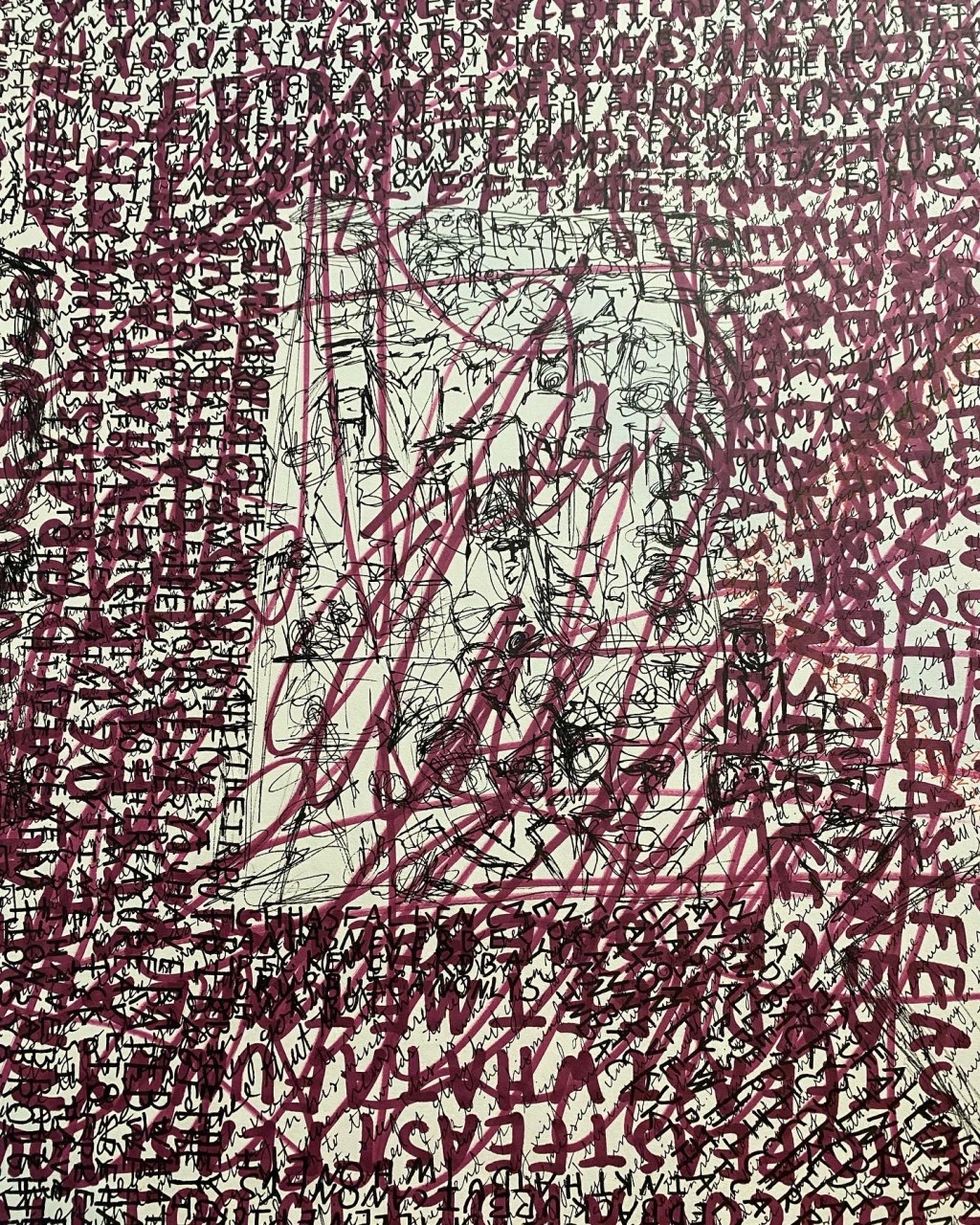

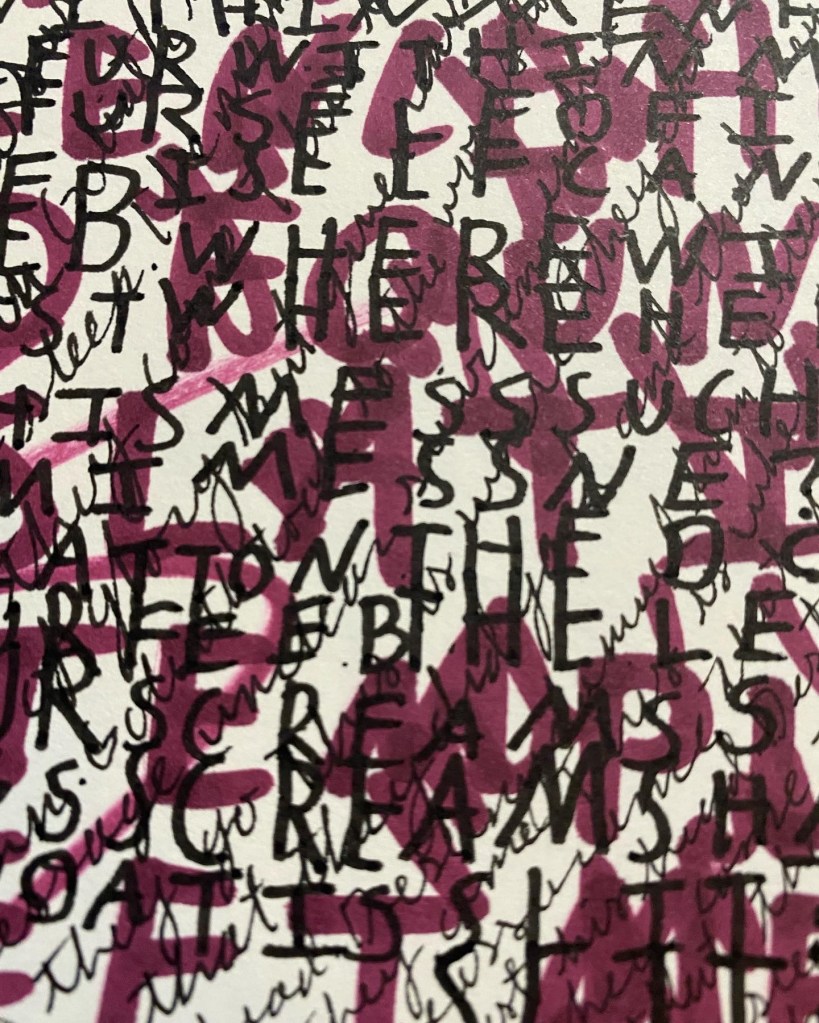
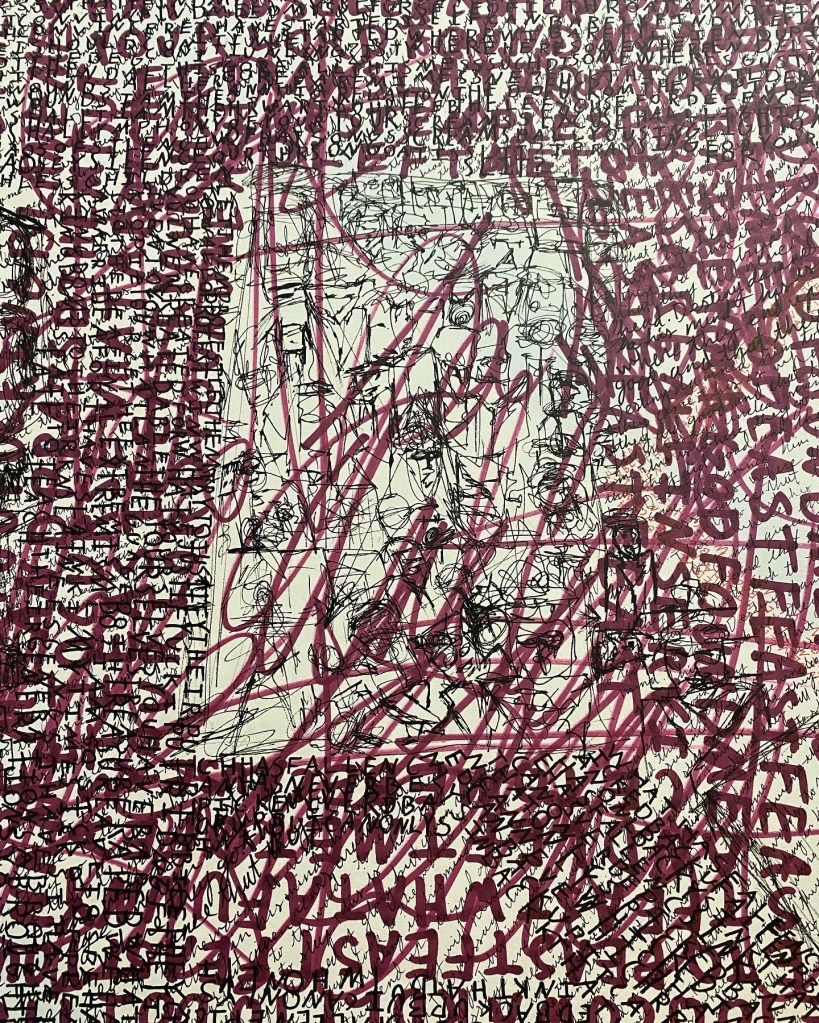

“Goliath took to the woods to rest his head.
Destiny had damned him to sleep,
The message unclear doomed1 to swirl2 inside Goliath’s3 head.
This is where they come.
This is where they go.
This is where they end up.
Stripped of glory but given reassurance.
That they did good.4
[…] That they will never return.”
This is a poem I wrote during my sophomore year of college.
I have since edited this poem. The revisions are demonstrated by the footnotes below.
Another poem that I used when creating this piece is “That which has fallen.” These poems have influenced the themes within other text displayed.
There are powers that we are still unaware of. There are creatures asleep beneath the mantle of the earth, ignorant of the trifles of man. And yet, due to God’s destiny instilled within humanity, or humanity’s unwillingness to become extinct; there is an objective inevitability of a “Goliath” archetype. Like a balanced ecosystem these “Goliaths,” through annihilation and violence, cultivate a “David” archetype ‘destined’ to overthrow the brutish ‘villain.’5
However, these are trivial examples, and many critics would argue that the story of David and Goliath‘s main purpose is to instill a message reminiscent to the saying “the higher6 they are the harder they fall.” Those same critics would go on to interpret a further meaning parallel to the common interpretation of the myth of “Achilles;” that even the strongest adversaries have a weakness.
These are hegemonic, sanitized interpretations of the tale used to teach basic morals to children. “Goliath” aims to project a new perspective on the biblical tale.
Some accurate common conceptions about the tale is that Goliath is depicted as a well-seasoned warrior that is massive in scale. However, many forget this excerpt that refers to David replying to Saul’s concerns about him confronting Goliath;
Your servant has been keeping his father’s sheep. When a lion or a bear came and carried off a sheep from the flock, I went after it, struck it and rescued the sheep from its mouth. When it turned on me, I seized it by its hair, struck it and killed it. Your servant has killed both the lion and the bear; this uncircumcised Philistine will be like one of them, because he has defied the armies of the living God.
Upon reading this, the viewer may come away with the notion that the message conveys the pure power of God’s strength exhibited by THIE’s children. Again, this is not the view I intend to project through my piece.
I do believe humans are capable of replicating Hell on earth. I even believe that Hell may not exist due to humanity’s proficient ability to cultivate suffering. But, I do not believe that humans are all powerful.
THE PATHETIC TIMELINE THAT PLAYS WHILE YOU SINK
WHAT USELESS FOOTAGE
WHAT LACK OF SUBSTANCE
YOU HAVE NEVER BEEN ABLE TO SWIM WITHIN THIS MIRE
NO ONE HAS
WHAT A FUNNY NAME TO CURSE
WHAT AN EASY WAY OUT
If Goliath represents the pinnacle of human strength and cruelty, and David represents the power that God may instill; the resolution becomes anticlimactic. Another miracle of God demonstrated by violence.
SO.
FUCKING.
WEAK.
David demonstrates how vulnerable Goliath is by such a simple act of murder (especially within the context of his proven strength, reserved to enact an efficient killing). He also demonstrates Goliath’s arrogance, and eliminates the trend of this strategy in warfare. With this in mind, another question may arise within the viewer; Which can be stronger, humanity’s appetite for cruelty or their7 arrogance?
This is not the intended meaning of the piece, and I deem as a superfluous comparison.
Another interpretation could be that an intimidating exterior signifies insecurity and weakness. While I do commonly agree with this sentiment, that is not the intended interpretation that this piece aims to proliferate.
There are those chosen, bred, or framed to be contemporary Amalekites. To be legends of affliction and tragedy. These who are chosen are not meant to be martyrs, wakeup calls, or public executions.
They are reminders.
Of how disempowered we are. How trivial and weak we really are. Amongst infinite experience and earned entitlement; we are nothing compared to those in slumber.
Their whispers come to me at night and influence my art. The imperceptible snores and shifted growls signal our fragility. Goliath is an archetype that can be used to to accurately explain our impact on climate change, war, and other international crisis’. But who is that force that directs them to the woods.
What power forces them down to rest, to never return?
What enlightened fears could Goliath tell us? What new darkness is there to explore? How exigent are the possessions that hypnotize our species?
What do they know that you don’t? Where did the David’s go? Who buried Goliath, and where is that hero when you need ’em?
God may be light, but Satan is not darkness. Satan is a harbinger of rot, a canary set off by decay. THIE is our connection to those who slumber, and attempts to educate us on how to appease THEM. Satan is a steward of the earth, it holds light within THIE’s horns.
The darkness eliminates.
THE NAME STRIKES FEAR INTO THE HEARTS OF ANGELS
TETRAGRAMMATON, STONE SPLIT BY SEWER SPIT
The drool coalescing into a puddle of saliva strangles those present.
Isolation never existed,
Loneliness a defense mechanism,
Solitude a Heaven we cannot reach.
THEY GROWL.
THEY GROW.
THEY SINK.
THEY ABSORB.
11″x17″
- Omitted ↩︎
- Changed to “swirled,” ↩︎
- Changed to “his,” ↩︎
- Changed to “,
And that…” ↩︎ - Words such as destined and villain are in quotes in order to signify multiple other words that could replace these while still retaining the intended meaning. Words and phrases include “pressured,” “forced,” and “warmonger,” and “drone” for destined and villain respectively. ↩︎
- stronger? ↩︎
- Our ↩︎
 ZCUMCORE
Leave a comment